
Labial closure
Address documented motor needs related to oral containment, saliva control, cup drinking, or other functional lip-seal tasks.
Adjunctive oral-motor rehabilitation
ISO Metrik may support selected facial and oral-motor goals when use is within professional competence and scope, based on individualized evaluation, and connected to documented communication or swallowing needs.
Diagnosis alone does not establish that resistance is appropriate. The SLP identifies the functional motor target through assessment.
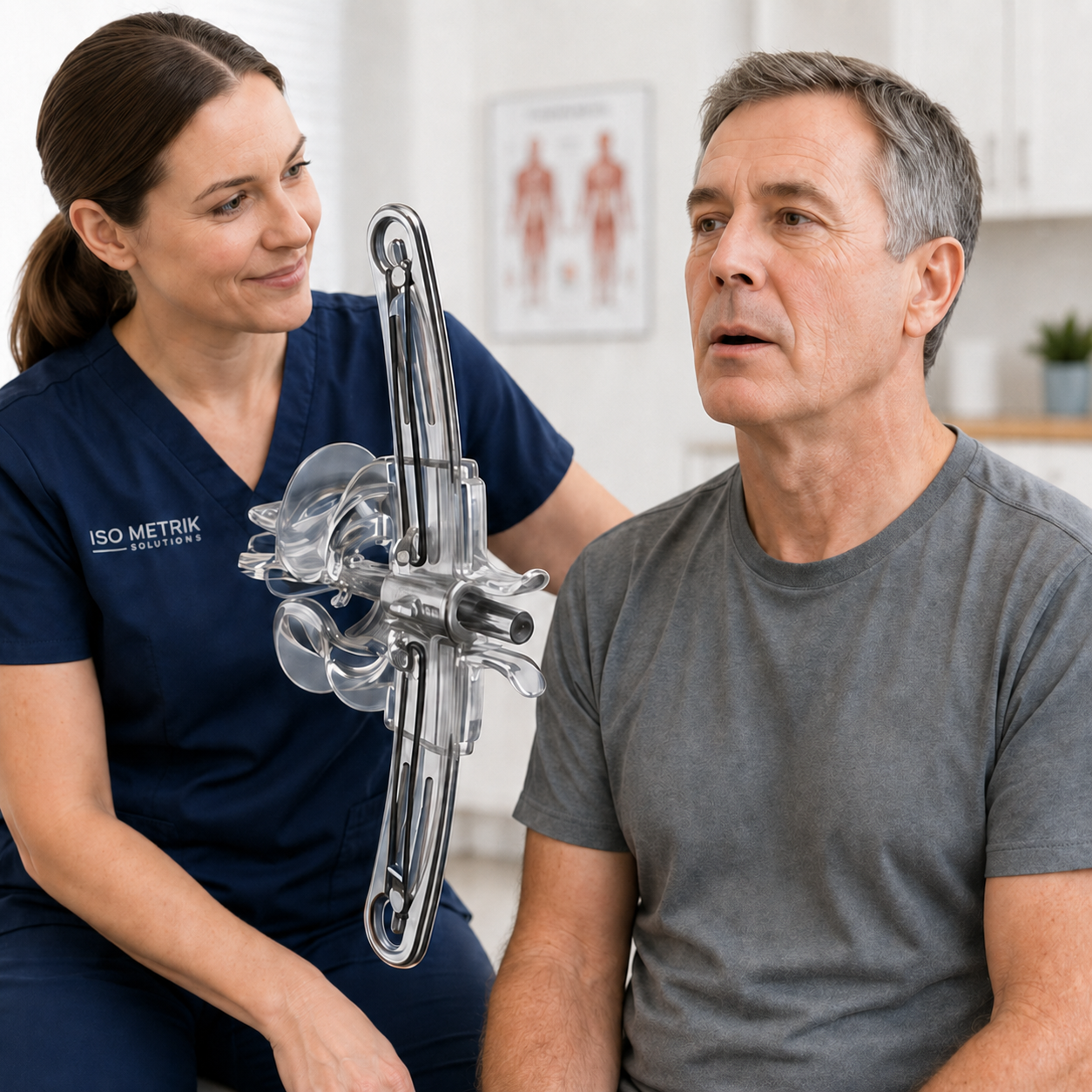
Clinical fit
The SLP first identifies the communication, oral-motor, or swallowing-related complaint; completes the appropriate assessment; establishes a measurable motor goal; and determines whether resistance is safe, relevant, and likely to support functional transfer.
Potential targets
The device is an adjunct to skilled care—not a diagnosis, a stand-alone swallowing evaluation, or a replacement for established SLP interventions.
Address documented motor needs related to oral containment, saliva control, cup drinking, or other functional lip-seal tasks.
Address labial weakness or reduced control affecting bilabial or labiodental production within an appropriate motor-speech plan.
Consider resistance only when documented oral-motor impairment affects containment or manipulation and the task is clinically safe.
Connect movement and symmetry goals with nonverbal communication, social participation, and confidence.
Monitor lip seal, movement quality, and motor accuracy when performance declines with fatigue.
Provide a provider-directed home program only after safe, accurate technique and appropriate stopping rules are established.
Scope and competence
Use must remain consistent with the SLP’s education, training, experience, state law, facility policy, and the individual plan of care. When dysphagia is suspected, airway safety and the appropriate swallowing assessment come first.

Clinical reasoning
A diagnosis alone does not establish candidacy for a resistance-based activity.
Clarify what the patient cannot do, how consistently the problem occurs, and why it matters to participation.
Evaluate the relevant facial, oral-motor, motor-speech, feeding, or swallowing domain within professional scope.
Consider diagnosis, recovery stage, tissue and dental status, cognition, pain, fatigue, aspiration risk, and the need for medical or instrumental assessment.
Connect the selected motor target with a functional communication, oral containment, or swallowing-related outcome.
Record performance, compensations, symptoms, fatigue, functional transfer, and the rationale for continuing, modifying, or stopping.
Interprofessional coordination
Overlapping facial and oral-motor needs require coordinated responsibility rather than assumed scope.
Evaluates communication, motor-speech, feeding, swallowing, and relevant oral-motor function within individual competence and scope.
Addresses movement, strength, neuromuscular re-education, and functional rehabilitation within PT scope and the coordinated plan.
Provide diagnosis, medical management, clearance, precautions, and specialty input when neurologic, facial nerve, surgical, or systemic issues are present.
Address dentition, occlusion, oral tissue, jaw status, and dental or oral-maxillofacial factors affecting candidacy and use.
SLP documentation
Documentation should identify why the activity is clinically relevant, how it was delivered, what the patient did, and whether it transferred to function.
Record the relevant impairment, activity limitation, participation impact, precautions, and candidacy decision.
State the measurable communication, oral containment, or swallowing-related result the motor activity is intended to support.
Record setup, resistance, repetitions, holds, rest, cues, compensations, assistance, and the patient’s response.
Document clinical and instrumental considerations, food or liquid restrictions, medical coordination, and stopping criteria when applicable.
Describe whether change carries into speech, expression, oral containment, eating, drinking, or another functional task.
Explain the rationale for continued skilled care, modification, home practice, referral, reassessment, or discontinuation.
Next step
Discuss scope, candidacy, oral-motor goals, swallowing safeguards, documentation, provider training, and implementation support.