Module 1 — Clinical Foundations and Facial Function
Facial-function rationale, measurable rehabilitation, clinical goals, provider responsibilities, and evidence boundaries.
Provider readiness
The training pathway prepares qualified providers to understand the device, screen patients, fit and sanitize components, select parameters, monitor response, and document care responsibly.
Eligibility, supervision, and permitted use depend on professional credentials, competence, facility policy, and applicable law.

Who training is for
Licensed clinicians receive clinical implementation training; clinic leaders prepare governance and quality systems; support staff learn appropriate workflow, sanitation, inventory, scheduling, and escalation; and referral partners receive orientation on referral, evidence, scope, and regulatory boundaries.
Curriculum
Each protected module provides structured lessons and a required assessment. Completing all nine online modules establishes knowledge readiness for the separate practical competency review and final certification process.
Facial-function rationale, measurable rehabilitation, clinical goals, provider responsibilities, and evidence boundaries.
Control before force, movement quality, neuromuscular re-education, motor learning, progression, and Isokinetic-Style Cadence Training.
Device components, material families, force transmission, inspection schedules, maintenance, storage, and stop-use criteria.
Four working axes, neutral position, pre-placement screening, standardized placement, alignment, and troubleshooting.
Horizontal, vertical, diagonal, and combined patterns with isometric, isotonic, concentric, eccentric, cadence, endurance, and functional training.
Clinical precautions, contraindications, compensatory movement, fatigue, synkinesis, adverse responses, and stopping decisions.
Lowest effective demand, dosage variables, criteria-based progression and regression, measurement, and response tracking.
Evaluation-to-reassessment workflow, treatment documentation, home-program controls, team readiness, and quality systems.
Knowledge readiness for device setup, screening, clinical reasoning, instruction, documentation, and the authorized practical review process.
Applied learning
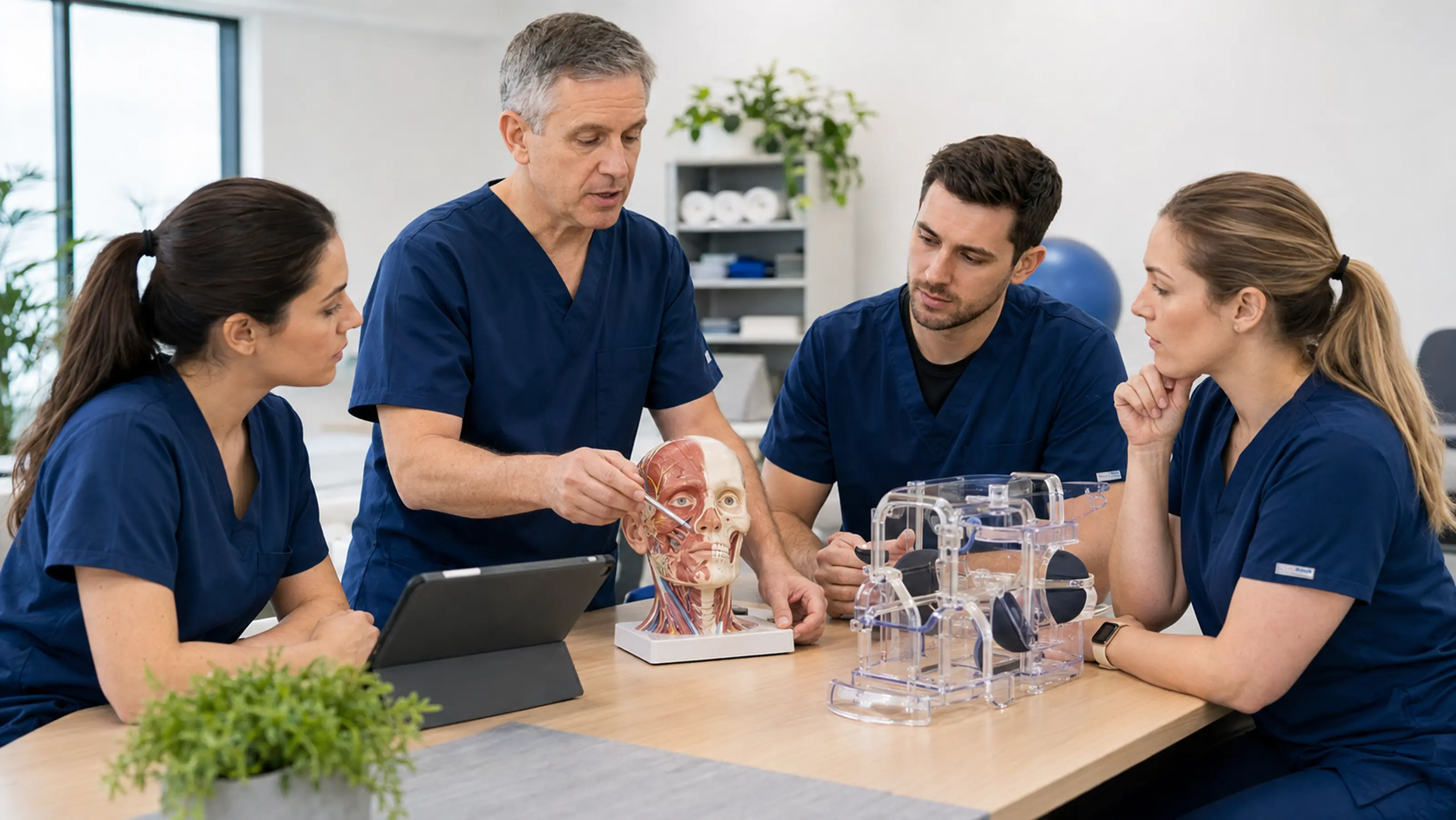
Training connects product knowledge to the provider's actual responsibilities—from the first screening decision through patient instruction, progress review, and escalation.
Competency pathway
Online curriculum completion confirms knowledge readiness. Final certification is documented only after the required assessments and authorized practical competency process are completed.
Work through every protected lesson covering clinical foundations, device use, safety, dosing, implementation, and certification readiness.
Complete the scored assessment at the end of each module and meet the program's passing requirement.
After all nine modules are passed, submit the portal request for authorized practical review.
Show safe inspection, assembly, placement, clinical reasoning, patient instruction, documentation, and stopping decisions.
Certification is issued only after the authorized reviewer approves the practical competency record and required sign-off.
Use updated materials, complete required refreshers, and repeat competency review when protocols or device components change.
Implementation resources
Structured tools help clinicians apply the same safety, fitting, treatment, documentation, and quality standards across the care pathway.
Prompts for history, precautions, clearance, dental and tissue status, recovery stage, and escalation.
A consistent sequence for inspection, assembly, fit, alignment, comfort, insertion, removal, and teach-back.
Fields for movement, position, resistance, dosage, rest, cueing, assistance, tolerance, and response.
Comparable measures, functional progress, adherence, symptoms, goal status, and rationale for modified or continued care.
Patient-facing setup, prescribed parameters, cleaning, storage, stopping rules, and clinic contact instructions.
Processes for product concerns, adverse responses, staff questions, retraining, and corrective action.
Next step
Tell us your discipline, setting, team roles, and implementation goal so we can discuss the appropriate ISO Metrik training and certification pathway.