
Bite plate
Provides stable intraoral anchoring and distributes occlusal forces.
The technology
A modular rehabilitation platform that helps clinicians select resistance, target perioral muscle groups, and advance loading as strength and function improve.
The treating clinician remains responsible for candidacy, fit, resistance selection, progression, safety, and follow-up.
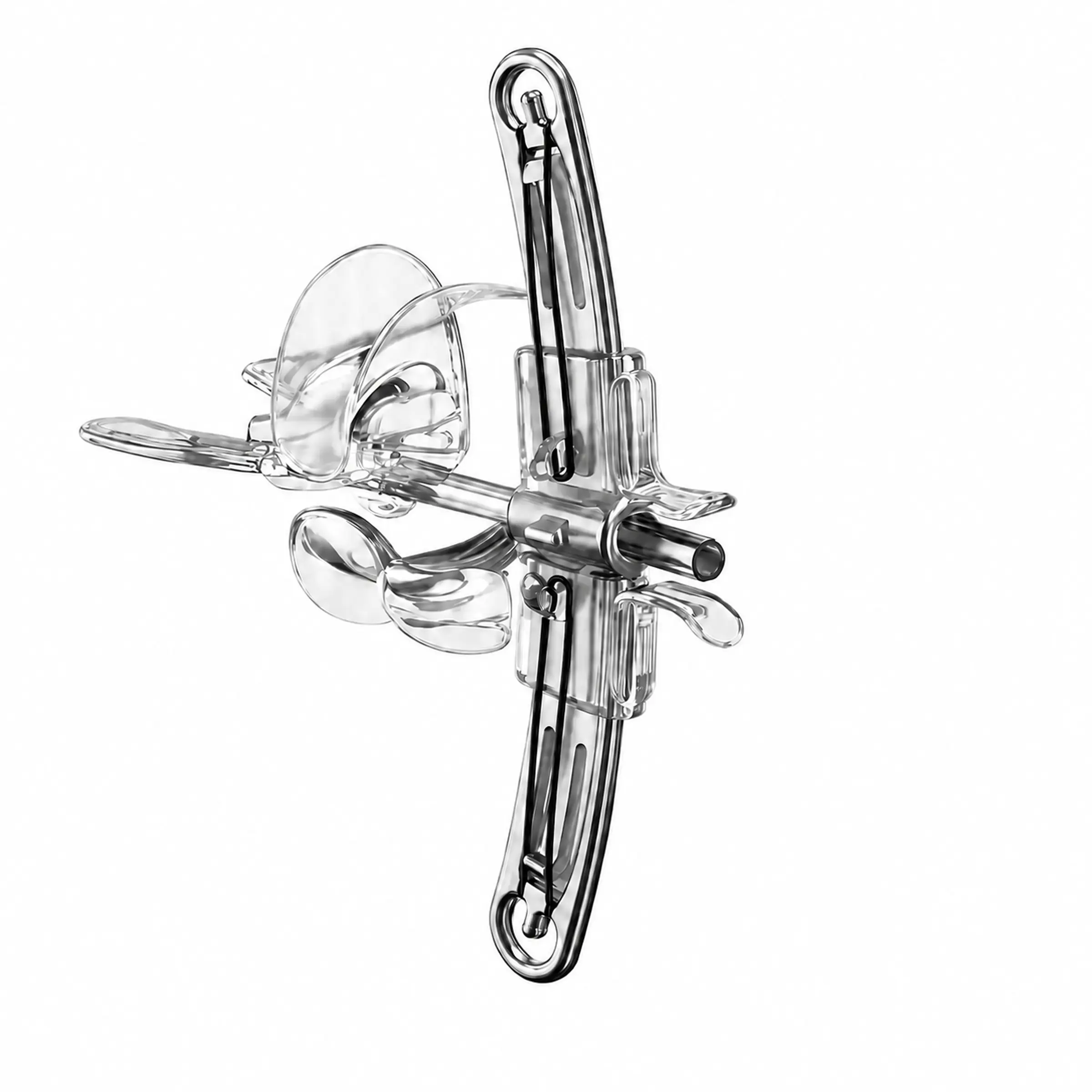
Modular architecture
The platform combines intraoral anchoring, controlled glide, perioral engagement, and interchangeable resistance so a trained provider can define and document the exercise setup.
Core components
Each component has a distinct mechanical role within the provider-directed platform.
Provides stable intraoral anchoring and distributes occlusal forces.
Supports controlled lateral and horizontal movement against resistance.
Engage the perioral region and surrounding musculature.
Provide interchangeable loading levels for structured progression.
Three therapy principles
The provider can configure the platform around familiar resistance-training principles and the patient’s assessed needs.
Provider-directed workflow
The device configuration is part of a broader clinical process rather than a stand-alone exercise prescription.
Document symmetry, movement, strength, endurance, coordination, and functional limitations.
Select the therapy mode and establish resistance, position, range, repetition, hold, rest, and frequency parameters.
Compare follow-up performance, movement quality, tolerance, and functional response with the patient’s starting point.
Refine resistance and exercise parameters as recovery advances and the provider’s reassessment supports change.
Clinical controls
The platform is intended to support a documented clinical pathway from supervised fitting through reassessment and, when appropriate, a provider-assigned home program.
Record component selection, direction, position, resistance, dosage, and the functional goal tied to the activity.
Monitor quality, symmetry, range, fatigue, discomfort, substitution, and immediate or delayed response.
Advance only when reassessment supports a change in resistance, range, speed, repetitions, hold time, or task complexity.
Preserve the provider-defined configuration and limits when supervised technique supports an assigned home program.
Next step
Discuss device architecture, fitting, resistance selection, clinical workflow, training, and implementation with the ISO Metrik team.